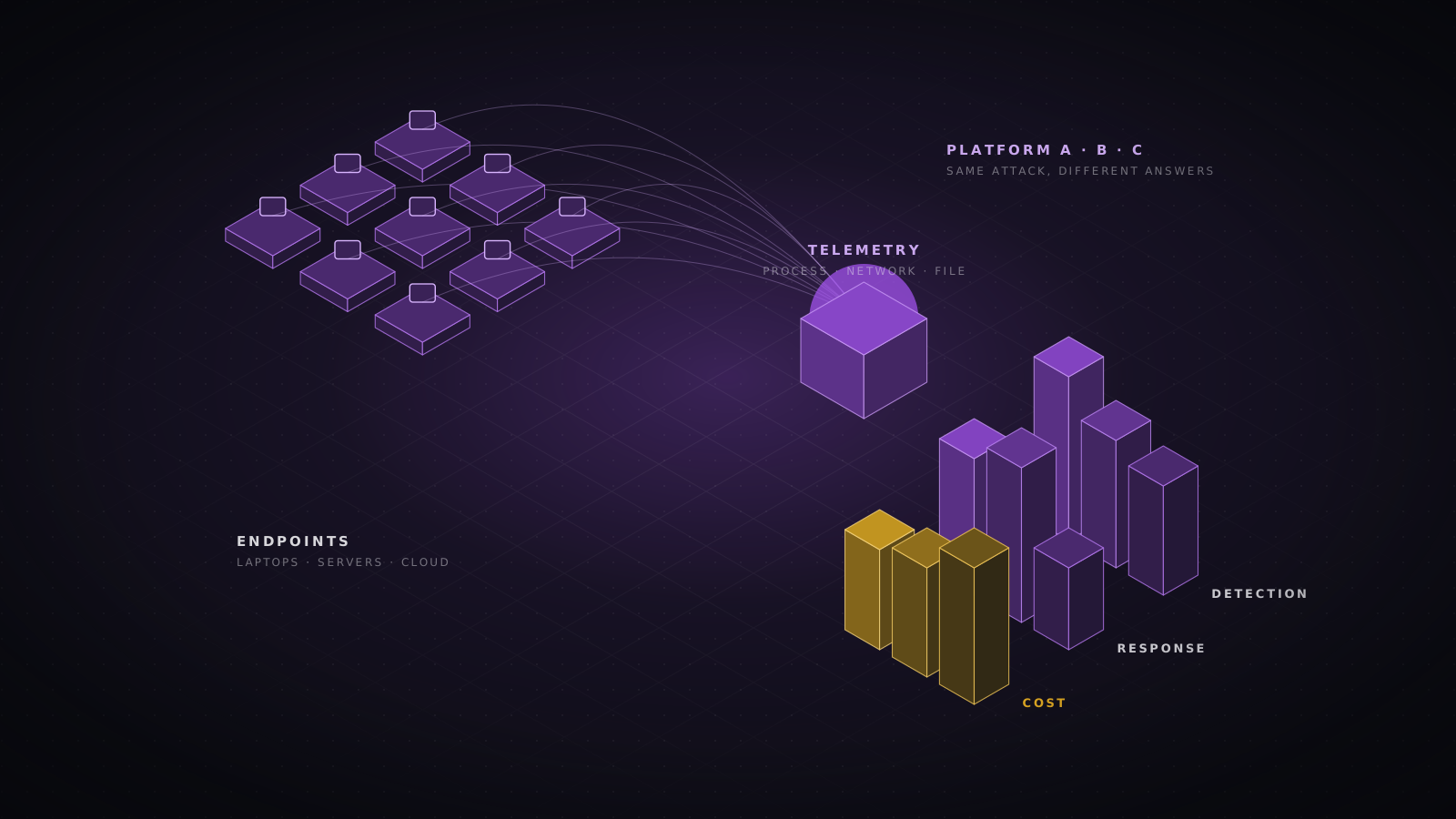
Every serious EDR platform today detects common attacks well. The differences that matter show up later: how quickly an analyst can understand an incident, how much the agent costs you in performance and outages, how well it fits the rest of your stack, and who watches the console at night. This comparison focuses on those operational differences rather than on marketing claims.
What to compare
- Detection quality against techniques you care about. MITRE ATT&CK Evaluations publish raw results per technique; read those rather than the vendor's summary of them.
- Investigation experience. How long does it take a junior analyst to explain what happened on a host?
- Response actions: isolation, process kill, file retrieval, remote shell, and rollback of ransomware damage.
- Operating system coverage, including Linux servers, macOS, legacy Windows and containers.
- Agent stability and update control. You should be able to stage sensor and content updates through test rings.
- Integration with your identity provider, email security, SIEM and SOAR.
The main platforms at a glance
| Platform | Known for | Watch for | Good fit |
|---|---|---|---|
| CrowdStrike Falcon | Lightweight cloud-managed agent, strong threat hunting and intelligence, large MDR offering | Premium pricing; module-based licensing adds up | Organizations that want best-in-class detection and a managed service |
| Microsoft Defender for Endpoint | Deep integration with Defender XDR, Entra ID and Intune; Plan 2 included in Microsoft 365 E5 | Console and licensing complexity; best results need the wider Microsoft stack | Microsoft 365 E5 customers and Windows-heavy estates |
| SentinelOne Singularity | Autonomous on-agent detection, Storyline event correlation, ransomware rollback on Windows | Tuning is needed to keep autonomous actions safe on critical servers | Lean teams that want strong automatic response |
| Palo Alto Cortex XDR | Correlation of endpoint with firewall and network data, path to Cortex XSIAM | Strongest value when paired with Palo Alto network products | Existing Palo Alto network customers |
| Trend Vision One | Broad coverage including servers, legacy systems and email | Broad platform can feel less focused than specialists | Mixed estates with older servers and OT adjacent systems |
| Sophos Intercept X | Anti-ransomware protection, simple management, widely used MDR service | Fewer advanced hunting features than the top tier | Small and mid-sized organizations |
| Elastic Security | Open detection rules, endpoint agent inside the Elastic stack, flexible pricing | Needs in-house engineering skills to run well | Teams already running Elastic or building their own SOC tooling |
Lessons from operating EDR at scale
An EDR agent runs with kernel-level privileges on every machine you own, which makes it both your best sensor and a single point of failure. The July 2024 incident, in which a faulty CrowdStrike content update crashed millions of Windows hosts worldwide, showed what that means in practice. Whichever vendor you choose, insist on staged deployment rings for sensor and content updates, documented recovery procedures, and a tested plan for booting into safe mode at scale.
- Run the proof of concept on real endpoints, including your heaviest developer laptops and busiest servers, and measure CPU, memory and disk impact.
- Simulate attacks with an open framework such as Atomic Red Team and time how long each product takes to alert and how clear the alert is.
- Check exclusions. Every product needs some, and badly scoped exclusions are a favorite place for attackers to hide.
- Confirm how long telemetry is retained and what it costs to keep it longer.
Who watches the console matters more than the logo
An EDR alert at 2 a.m. is only useful if someone acts on it. If you do not have a 24/7 SOC, the vendor's MDR service or an independent MDR provider is part of the purchase, not an extra. Compare response times written into the contract, which actions the provider may take without asking, and how they hand an incident over to your team.
How we would choose
Start from your environment. If you already pay for Microsoft 365 E5, Defender for Endpoint is hard to beat on value and integration. If you need the strongest detection and hunting with a managed service, CrowdStrike and SentinelOne lead most shortlists. Palo Alto and Trend make sense when they extend platforms you already run. Sophos suits smaller teams that want simplicity, and Elastic suits teams that want to own their detection engineering. Then let a proof of concept on your own endpoints make the final decision.
- EDR
- XDR
- CrowdStrike
- Microsoft Defender
- SentinelOne
- Tool comparison